
The i-CAC journal
Gérard GAROUSTE
 Enlarge the illustration
Gérard GAROUSTE is one of the most important French painters working today; he ranks 6th in the “TOP 500” of i-CAC.
More than 80 works, some of them large-format, were exhibited at the BAM in Mons until 29 January 2017, giving an original overview of the entire career of this artist, whose main sources of inspiration are myths, legends and the Jewish and Christian religions.
The Salle Saint-Georges, meanwhile, hosted an installation specially designed by Gérard GAROUSTE, which invited visitors to lose themselves in the twists and turns of a labyrinth made up of nearly 35 monumental canvases.
He has created works and decorations for the Élysée Palace, sculptures for Évry Cathedral, the ceiling of the theatre in Namur, a fresco for the wedding hall of Mons’s beautiful Gothic town hall and the stained-glass windows of the church of Notre-Dame de Talant.
He created the stage curtain for the Théâtre du Châtelet and was commissioned to produce a monumental work for the Bibliothèque nationale de France, combining painting and wrought iron. In 2001, at the Fondation Cartier, he presented Ellipse, a set of canvases mounted on a structure he designed himself. In 2008, commissioned by the French State, he created the design for a monumental 24 m2 Aubusson tapestry, le Murex et l'Araignée, installed on the grand staircase of Aubusson town hall. He is represented by the Galerie Daniel TEMPLON.
His figurative paintings often refer to the Bible, which he has studied intensively alongside the Hebrew he began learning in the late 1990s.
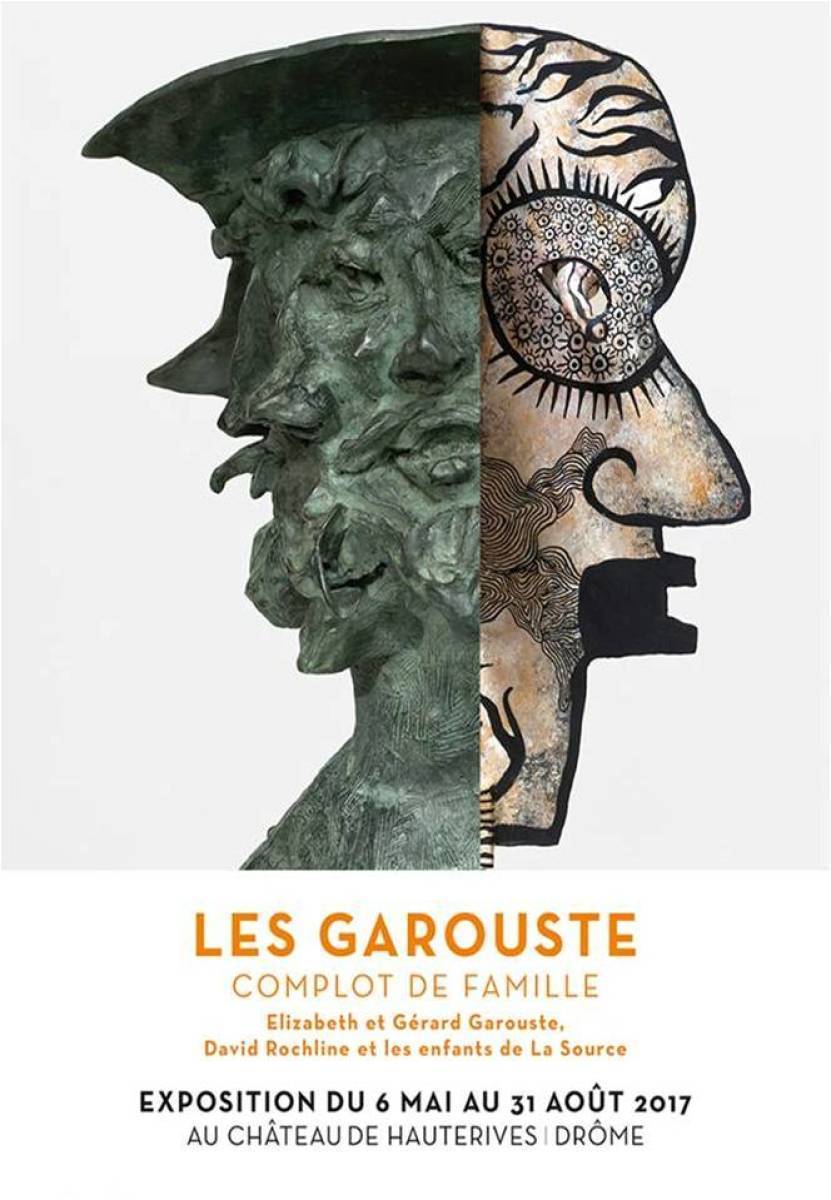
A key milestone in his work was the founding in 1991 of the association La Source in Guéroulde, in the Eure, which helps children and young people from disadvantaged backgrounds, some facing social exclusion, to flourish by taking part in workshops led by professional artists.
Gérard GAROUSTE, President of “La Source”:
“La Source allowed me to fulfil a dream: to found a place of liberation and creation that gives disadvantaged children the keys to move forward: tolerance, discovery through contact with artists, and curiosity. There are others, such as showing them that the universe is made of questions.
Today, I would like to reproduce the La Source model elsewhere in France and, why not, in Europe. New sites are being planned, based on the model we have championed for 20 years: carefully combining social work, education and artistic creativity. Social, because it is aimed at children and families in difficulty; educational, because it involves schools; and artistic quite simply because I am an artist.
And I know that practising art can be a real trigger. My own experience is the driving force I use to help children made vulnerable by life to gain independence and the ability to carry out projects, and so regain their self-confidence.
At La Source, in contact with an artist, children learn to use their imagination. By learning to make, they learn to see, to be, to know themselves. Taking action goes hand in hand with taking responsibility, a personal and collective commitment that helps them assert their identity, find their place in society and look to the future. This stage marks the beginning of a desire to take part in life in society and in the life of society.
The work produced in the workshops takes the form of exhibitions, publications, films and performances. This approach gives them recognition in the eyes of their families and helps change the way others see them.
Art as practised at La Source is a lever for citizenship, not a luxury or an end in itself.”